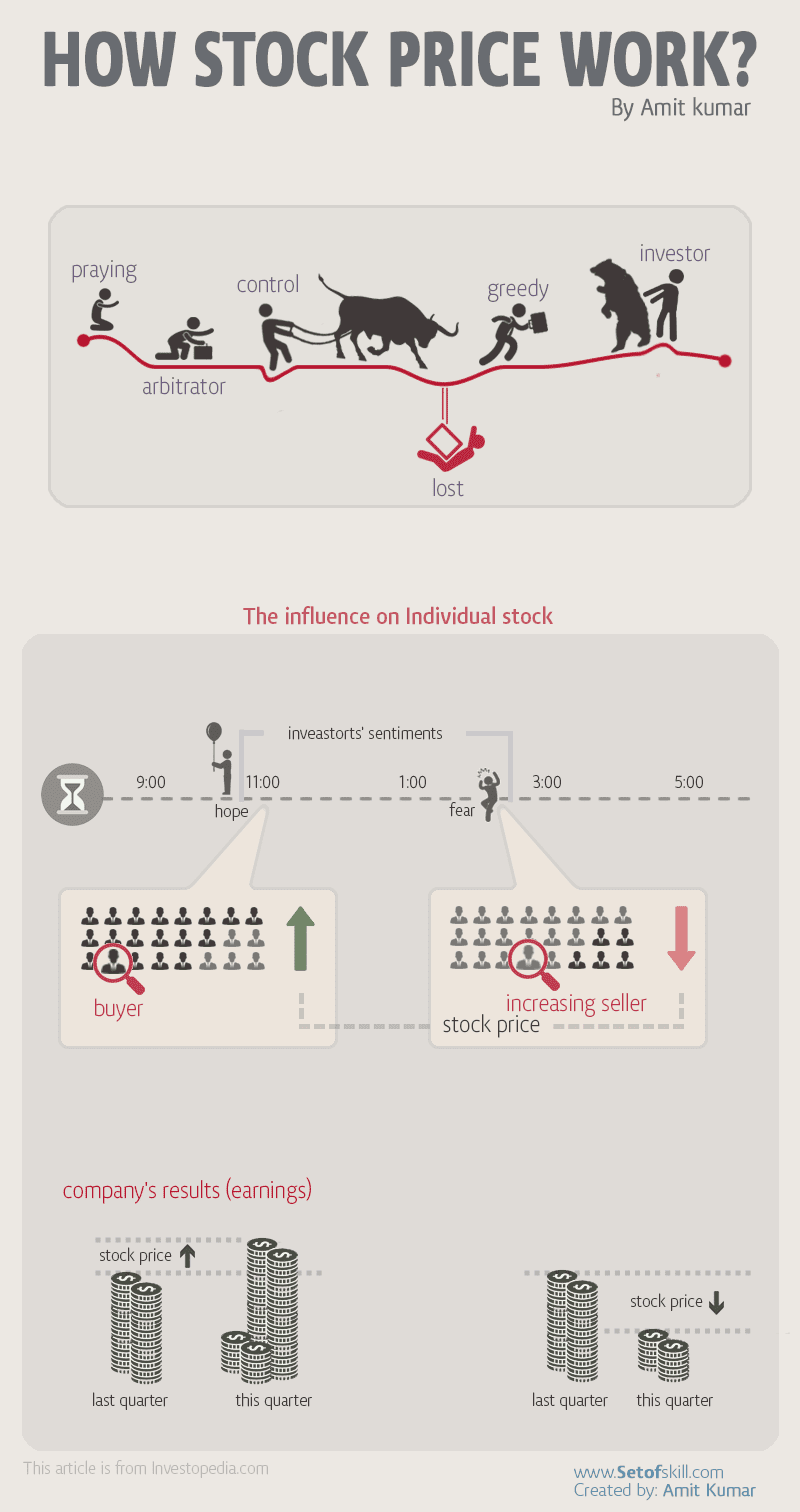
Here is a visualization of the How stock price works!
At the most fundamental level, supply and demand in the market determine stock price.
Price times the number of shares outstanding (market capitalization) is the value of a company. Comparing just the share price of two companies is meaningless.
Theoretically, earnings are what affect investors’ valuation of a company, but there are other indicators that investors use to predict stock price. Remember, it is investors’ sentiments, attitudes and expectations that ultimately affect stock prices.
There are many theories that try to explain the way stock prices move the way they do. Unfortunately, there is no one theory that can explain everything.
The primary explanation to target this subject is based from the reality the great bulk of e-mails. I get are tightly connected to that issue. The number one problem out there is generally one of the following:
Getting ‘stuck (stayed)’ with a position.
A position huge quantities and devastating losses.
A single stock position that is way too big.
The main problem is always the same exact above. At some point in time things changed and control shifted. You started off being in control and then, The stock you bought is beginning to control you. The position then went on to harmful your financial capital. And finally harmful for your emotional thinking and your capital. Again, the beginning trigger is always ‘Control’. To be more accurate: The loss of control. In this article is exactly what you need to do in order to escape “losing control”:
No game plan if you think the stock goes to the downside.
Fixed: Apply stop losses. Create a habit of getting into your stop loss as soon as opening a new position.
Rationalize(thinking) losses and making excuses.
Fixed: Your stop loss will handle of any rationalizing.
Trusting in a company, management, your stock advisory, fundamentals etc.
Fixed: Your stop loss will protect you from RED-events, issues you do not recognize or might not predict and more.
Trading Stop loss ?
Observe what the different solutions have in usual? You got it. A stop loss. It’s not affected by emotions and systematization. And secure you to a position if a stock achieves a predefined price.
In making a long story in short words : You need to manage anything you may in order to recover control and then keep in control. If your position is in control of you, do anything it takes in order to return in control. Sell? Absolutely Yes, that is correctly what I replied: SELL Or EXIT. Go to cash. Totally free your mind and stop rationalizing a losing position. Take a break. Re-group. Restore your mental capital and emotions. Next come back and stay to a controlled way of trading. Use stop losses and stay in control. MoneyMunch says: each one problem is as a result of traders not cutting their losses and allowing all of them increase into big losses. Trading stop loss order. Trading stop loss. again, I am saying trade in stop loss order.
At this time, NSE have greater than 345 stockbrokers authorized with it for stockbroking business. BSE includes a huge list of trading members/brokers than NSE. Any person who would like to take registration with NSE for stockbroking does have to pass through an online exam of NISM Capital Markets (Dealer) module apart from having other qualifications criteria detailed by NSE India. Right here is the list of some famous online stockbrokers in India.
If your stockbroking firm is not mentioned below, please lets know by sending an email to [email protected], we will include it below. In case readers come upon any newer trading members/brokers – you might talk about it with us by commenting below this post. We value your help.
It is required to select the broker right after proper research. The brokerage you pay can make a major variation in the return you create in the long time run, and in most cases, it is confusing to transform the brokers once you have chosen your broker. So That, do correct studies prior to getting your choice. Most of the important information is available on the website and before wrapping up contact the broker and verify their brokerage plan considering some details can change.
List of Online Brokers In India
5paisa.com: Buy and sell shares on 5paisa.com with speeds comparable and at times better than NSE’s NEAT Terminal. http://www.5paisa.com
Aditya Birla Money Ltd: ABM formerly known as Apollo Sindhoori Capital Investment is a leading player in broking space since 15yrs. http://www.adityabirlamoney.com/ Advani Share Brokers: Advani Share Brokers, the reputed Bombay based investment house, operates from India’s financial hub, Dalal Street, since 60 yrs. http://www.advanishares.com/ Agroy: AFIL is the group’s flagship company engaged in capital markets as a premier financial and stockbroking house since 18 yrs. http://www.agroy.com/ Anand Rathi Securities ltd: Anand Rathi Securities provides financial & advisory services including brokerage & distribution of equities, commodities supported by powerful research teams. http://www.rathi.com/ Angel Trade: The Angel Group has emerged as one of the top 5 retail stockbroking houses in India. http://www.angeltrade.com/ Aracade Share & Stock brokers: Arcadia group has philosophy of client servicing backed by all principal Indian Stock and Commodity. http://www.arcadiastock.com Dalal & Broacha stockbroking pvt ltd: The Company is the member of The Stock Exchange Mumbai NSE and the OTC exchange of India. http://www.dalal-broacha.com/ Dalmia Securities: Dalmia Securities (P) Ltd., is one of the market leaders in the Indian securities market. http://www.dalmiasec.com/ Emkay: Emkay is a Financial Services Company promoted and run by professionals. http://www.emkayshare.com Ethical investment solutions pvt ltd: It is committed in providing you superior customer service. http://ethical360.net Geojit Financial services ltd : Company has a network of over 300 branches in India and abroad, rendering quality equity trading services. http://www.geojit.com/ ICICI Direct : Online share and mutual funds trading facility by the ICICI group. http://www.icicidirect.com/ IL & LS Investsmart : IIL is a premier financial service organisation providing individuals and corporates with customised financial management solutions. http://www.investsmartindia.com India Bulls : Indiabulls is India’s leading retail financial services company with 70 locations spread across 62 cities. http://www.indiabulls.com/ Indianstockmarket.net : Indianstockmarket.net is an effort to educate Indian investor by providing stock news, stock market websites, informative articles, resources to various investment guides. http://www.indianstockmarket.net/ Indira Securities: FIRM has grown from a modest stockbroking firm to the current status with substantial business base with 15 yrs experience. http://www.indirasecurities.com/ Indus Invest: INDUS is one of the well established professional stockbroking company in north India. http://www.indusinvest.com InvestMentor Securites : ISL is a leading stockbroker of Gujarat, India. ISL has a seat on India’s largest stock exchange. http://www.investmentoronline.com Investment Research& Information services(IRIS) : Myiris.com provides online trading service of Indian stock and mutual funds. http://www.myiris.com/ Jaypee Capital Services : It has the expertise and the experience to capitalize on daily stock movements and employ over 20 specialist traders certified by the NSE. http://www.jaypeecapital.com/index.html Khandwala securitiesLtd : Khandwala group has had over six and a half decades of experience in the financial services industry. http://www.kslinvestor.com/ Kisan Ratilal Choksey : We serve an eclectic clientele comprising High Net Worth Individuals, Corporates. http://www.krchoksey.com LKP : It is one of the most respected groups in India, offers a single window advantage to its clients for all capital and money market related activities. http://www.lkpsec.com/ Mangal Keshav : It has been a leading brokerage and advisory house offering a range of sophisticated advisory, financial trading and investment services. http://www.mangalkeshav.com Motilal Oswal: One of the top-3 stockbroking houses in India with 23 yrs experience. http://www.motilaloswal.com Mumbaibull.com : A guide to invest in Indian few nice tips to invest in India and Indian stock markets. A cautious approach for maximizing profits. http://www.mumbaibull.com/ Networth stockbroking Ltd: NSBL is a member of NSE & BSE on the Capital Market and Derivatives segment. http://www.networthstock.com/ Orient Capital Market: OCM was started 15 yrs ago with the sole aim to reduce the cost and improve the efficiency of the Broking system. http://www.orientcapitalmarket.com/ Pratibhuti : Pratibhuti is one of the prominent Indian stock Broking Company effecting business on India’s major bourses. http://www.pratibhuti.com/ RBK Share Brokers : RBK Share Broking Ltd is the member of Mumbai Stock Exchange, the premier stock exchange of India. http://www.religare.in/ Religare Securities Ltd: Religare Enterprises Limited (A Ranbaxy Promoter Group Company) provides integrated financial solutions to its corporate, retail and wealth management clients. http://www.religare.in/ Share Khan : Sharekhan brings to you a user-friendly online trading facility, coupled with a wealth of content that will help you stalk the right shares. http://www.sharekhan.com Sivan securities : Sivan is one of the leading Indian Investment Banker & Stock Broker with a strategic focus on South India. http://members.tripod.com/~sivansec/ Toss financial services : Toss strives for absolute professionalism and high degree ethical standards when it comes to the question of client’s interest. http://www.tossfinance.com UTI Securities : UTISEL was promoted as an independant professional entity in 06/94 by UTI. the entire share capital of UTISEL is now held by Administrator of Specified Undertaking of Unit Trust of India since 02/03. http://www.utisel.com/ Latin Manharlal: Latin Manharlal has grown over a period of experience and serving ever-growing clientele in the Capital Market and F&O Segment. The company is a Trading and Clearing Member Broker registered with both the exchanges (BSE/NSE) Under Cash, F&O Segments and Registered Trading Member under Currency Derivative Segment. http://www.latinmanharlal.com/
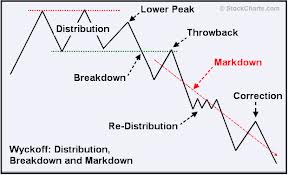
The Wyckoff Method is one of the four timeless approaches to market analysis (the other three being Dow Theory, Shabacker’s chart patterns, Elliott Wave Theory and Gann’s swing trading approach). It was developed in the early part of the 20th Century and has been continuously refined through the present day. The Wyckoff Method is a vital, classic approach to trading which reads the market through price bars and volume. Although technical indicators may be used, they are unnecessary under the Wyckoff Method.
Richard D. Wyckoff was a Wall Street broker and trader in the early part of the 20th Century. Wyckoff was a broker and witnessed the operations of the largest traders of his day first hand as an ‘insider’ and learned to translate their activities in the ticker tape and bar charts. As he watched traders and investors make poor trading decisions based on rumor, opinion and guesswork, he wrote a newsletter that quickly became so widely read on Wall Street that it would often affect stock prices. He later wrote courses for traders and books on tape reading (including the first day trader’s manual) and his experiences on the Street.
The Wyckoff Method has been used by astute traders for nearly 80 years. It is a complete method for understanding and trading the markets. It is used effectively by day traders, swing traders and investors in all markets including equities, commodities, index futures and FX with equal success. Many of today’s top market technicians acknowledge Wyckoff as the basis for their understanding of the markets, and the Method has spawned spin-offs such as VSA.
Dr. Gary Dayton is an expert in the Wyckoff Method. He has studied and applied Wyckoff for the past decade and has been mentored by an acknowledged Wyckoff master. Dr. Gary is also an outstanding educator of the Method who conveys the Wyckoff Method and principles in a simple and concise manner easily understood by his students.
Kind attention: this course is helpful for beginner and intermediate traders. It’s free for everyone. Advanced modules, trading strategies, and data (in-depth) are available for Moneymunch’s premium subscribers.
Get free important share market ideas on stocks & nifty tips chart setups, analysis for the upcoming session, and more by joining the below link: Stock Tips
Have you any questions/feedback about this article? Please leave your queries in the comment box for answers.
Disclaimer: The information provided on this website, including but not limited to stock, commodity, and forex trading tips, technical analysis, and research reports, is solely for educational and informational purposes. It should not be considered as financial advice or a recommendation to engage in any trading activity. Trading in stocks, commodities, and forex involves substantial risks, and you should carefully consider your financial situation and consult with a professional advisor before making any trading decisions. Moneymunch.com and its authors do not guarantee the accuracy, completeness, or reliability of the information provided, and shall not be held responsible for any losses or damages incurred as a result of using or relying on such information. Trading in the financial markets is subject to market risks, and past performance is not indicative of future results. By accessing and using this website, you acknowledge and agree to the terms of this disclaimer.
The two approaches to market timing—predictive and confirming—almost always give conflicting signals when analyzing movements of the same time domain. That is okay because they are used for different purposes and have different goals. If contrary opinion says that the market has reached bottom over the intermediate term, the other approach—trending indicators for the intermediate term—almost always indicates that the trend is still down. This is normal. Why? Because it is normal that investors become very bearish (furnishing us with buy signals using contrary opinion)as prices are plummeting and at their low. The large price drop makes the trend indicators point down, but the predictive indicators are showing that the end of the decline has been reached, and higher prices are ahead. However, there are times when the two approaches do not give conflicting signals, and these are very important to note. When predictive indicators such as contrary opinion strongly indicate higher prices, and the confirming indicators have already confirmed the start of a slight uptrend, that is the strongest buy signal there is. There is nothing more reliable or important than when this unusual situation happens. Why is this so? It is expected that, as prices move up, more and more investors will become bullish. When, however, the bearish sentiment stays high or even moves higher than prices also move higher, that is not expected, and so it is the sign of a very strong stock market. At these moments, what is happening is that no one believes the upward price movement is real or that it will last. This skepticism is the fuel needed to keep the movement going, usually for some time. The same holds true when both categories of indicators are confirming that prices are declining. If contrary opinion is extremely bullish and stock prices have already started down, so much so that trend-following indicators are confirming the downtrend, there is no more reliable or important sell indicator.
Setting Stops For Long Positions Here are a few suggestions on how to set stops for long (buy) positions.
Set the stop simply under yesterday’s low except if yesterday ended up being a big up day. Then move the stop closer to today’s open.
Package the stop simply under a current minor support amount.
3. Make use of the daily Average Real Range to determine the expected movement for the stock, and set the stop simply beyond the range amount.
Package the stop the instant your buy purchase has filled.
Move stops up like the stock rises, 1st to burst actually, then to safeguard profits. On top of a long positioning when you use trailing stops, don’t lower stops – just collect them.
Of the stock moves upwards and also tends to “top out” or market conditions become unfavorable, “tighten the stop.” In different statement, move the stop nearer to the current market price tag. Doing this can effectively employ a strong “upwards or out” strategy” – both the price goes up, or perhaps you are from the trade.
Setting Stops For Short Positions
Here are really a few suggestions upon how to package stops for short (sell) opportunities.
Upon daily charts, package the stop just above yesterday’s high unless it had been a big down day. Then move the stop nearer to today’s open.
Package the stop simply above a latest minor resistance amount.
Utilize the daily Average Real Range to determine the anticipated movement for the stock, and package the stop just beyond the range amount. (ATR is a feature within RightLine Charts.)
Set the stop the instant the order gets filled.
Move stops down as the stock declines, 1st to burst actually, then to protect revenues. As soon as you use trailing stops for a short positioning, don’t collect stops – lower them.
As the stock moves down and also tends to “bottom out” or perhaps market circumstances become bullish, “tighten the stop” that will effectively employ a “down or out” approach.